
Protecting the Rights of International Researchers
International students and scholars have always faced challenges and precarity on account of their status as visa holders. In 2020, the federal government increased this pressure by issuing a number of short-sighted and xenophobic policies, from requiring international students to attend classes in person during the COVID-19 crisis or risk deportation, to restricting H1B visas, to the Muslim travel ban, to restrictions on Chinese international student visas, and more. These actions have created tremendous stress, concern and uncertainty for international students/scholars and our futures.
By forming a union, International Student Workers can negotiate for additional protections.
Through their contracts, for example, Harvard international student workers have won increased job security by ensuring greater ability to work remotely if unable to return to the US, expanded support for immigration legal expenses including a fund, and leave for immigration-related proceedings. UC Postdocs have won increased rights for international Postdocs by ending UC’s practice of denying health benefits for many international Postdocs and ensuring equal treatment regardless of immigration status.
UAW has also been a critical resource and provided a political voice for international students and scholars to affect national policy. UAW Academic Workers have used their collective strength to:
- write thousands of letters to elected officials
- protest outside of ICE offices and share our stories with the press
- host information sessions with immigration attorneys
- and submit formal declarations filed in lawsuits to overturn xenophobic policies.
In October of 2020, UAW Academic Workers mobilized against a proposed rule by ICE to shorten visa stays for international scholars; thousands of public comments were submitted, including by the President of the UAW International. In July of 2020, thanks to the direct action by UAW Academic Workers across the country, in addition to efforts by our university and government allies, ICE backed down from its directive to deport international students taking online classes due to COVID-19. In 2017, the UAW International filed an amicus brief in the Supreme Court case challenging the Trump administration’s travel ban.
Working with members of Congress, UAW academic workers helped win the Optional Practical Training STEM extension. UAW Locals 5810, 2865 and 4121 also worked with Congressional Representatives Judy Chu (San Gabriel Valley, California) and Pramila Jayapal (Seattle) on a Dear Colleague letter demanding that Secretary of State Pompeo restore the validity period of Chinese international students’ entry visas from 12 months back to 60 months.
Nationally, the UAW represents more than 80,000 workers in higher education, a powerful force for effective lobbying, enabling UAW Academic Workers to help win an extension to the Optional Practical Training program for international workers in STEM fields in 2016.

Fiona (Xiaoge) Gao, Nutrition
“I support the Student Workers Union at TC because I believe that every student worker deserves fair wages, benefits, and working conditions. As an international graduate student worker, I am especially committed to advocating for a more supportive and equitable workplace—one that recognizes and respects the unique challenges faced by non-citizens.”

Katya Villareal Cavazos, Ph. D., Communication Sciences and Disorders
Unionizing TC student workers would give us a collective voice to advocate for our rights, creating a more equitable and supportive academic and work environment. This commitment to fairness and inclusion aligns with Teachers College’s mission to empower individuals through education.
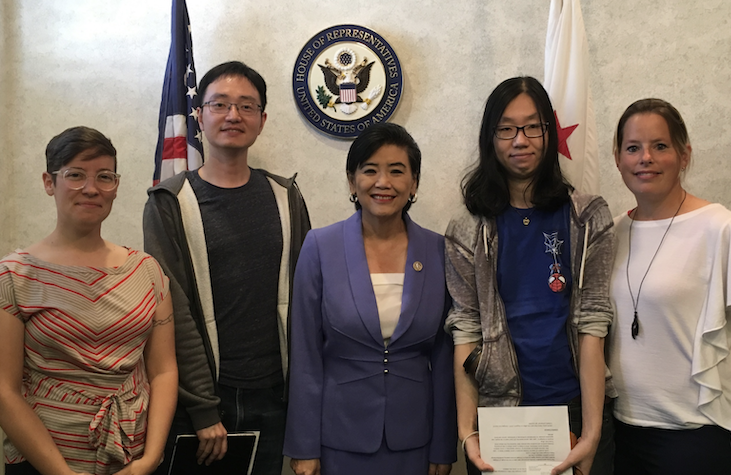
UAW Local 2865 and UAW 5810 union members with Congresswoman Judy Chu discussing her Dear Colleague Letter in support of Chinese international students at her office in Pasadena, 2018.
Frequently Asked Questions
What difference does unionization make for international students?
International students are an integral part of the community of student workers at Teachers College. In addition to the overall upheaval that accompanies relocation, we have to contend with unique challenges at the workplace: visa and immigration precarity, complicated tax laws, zero support finding housing and settling into New York City, and insufficient support from poorly-informed department administrators. This is where forming a union can help graduate student workers generally and international graduate student workers specifically! By unionizing, we can collectively bargain for a more supportive and equitable workplace that is sensitive to our status as non-citizens.
What difference does unionization make for international students?
International students are an integral part of the community of student workers at Teachers College. In addition to the overall upheaval that accompanies relocation, we have to contend with unique challenges at the workplace: visa and immigration precarity, complicated tax laws, zero support finding housing and settling into New York City, and insufficient support from poorly-informed department administrators. This is where forming a union can help graduate student workers generally and international graduate student workers specifically! By unionizing, we can collectively bargain for a more supportive and equitable workplace that is sensitive to our status as non-citizens.
What legal rights do international graduate student workers have to join and participate in a union in the U.S.?
Our right to unionize is protected under US Federal law, regardless of national origin and type of visa. The National Labor Relations Act does not differentiate between citizens and non-citizens. Its statutory protections extend to all workers, regardless of their status as immigrants to this country. International workers have the same legal rights to talk to our coworkers about the union, distribute union literature, wear union buttons and t-shirts, sign authorization cards, ask other workers to sign authorization cards, run for union leadership, and participate in contract negotiations. Tens of thousands of international graduate students are already members of academic unions like the Union of Student Workers of Columbia (UAW 2710), the Union of Academic Student Employees at the University of California (UAW 2865), the Union of Academic Student Employees and Postdocs at University of Washington (UAW 4121), and the Harvard Graduate Students Union (UAW 5118).
Can I sign a TCSW-UAW union authorization card if I’m on a F-1/J-1 visa?
As an international graduate student worker, your right to unionize is protected under U.S. Federal law, regardless of national origin and type of visa. Further, your right to belong to a union is protected by the right to freedom of association guaranteed in the United States Constitution. Student worker unions have existed for nearly 40 years and there have been no known cases of problems with either the law or with visa status because of union activity.
Will my relationship with my advisor or supervisor be affected?
It is illegal for an employer to retaliate against any student employee for exercising their rights under the National Labor Relations Act (NLRA). It would be a violation of the NLRA for your advisor or supervisor to retaliate against or penalize you for talking about or participating in union activities, including signing union cards, wearing union paraphernalia, or soliciting others (on non-work time and in non-work areas) to join.
Will signing a union authorization card impact current or future visa or permanent residency prospects in the U.S.?
As international graduate students, we are often worried about our legal status in the U.S. These concerns are heightened for those of us from countries without strong labor rights and protections. U.S. Citizenship and Immigration Services (USCIS) cannot ask you questions about your union membership or participation in lawful union activity. Nor can they use such information in determining the outcome of your immigration/visa application. Further, the National Labor Relations Act does not differentiate between citizens and non-citizens. Its statutory protections extend to all workers, regardless of their status as immigrants to this country. Out of tens of thousands of international graduate students, postdocs, and researchers that are part of UAW, there has never been any reported instances of participation in a union negatively impacting visa or permanent residency applications.
Are there any restrictions on political activity by international students?
All international students enjoy the same rights to freedom of expression and freedom of association as U.S. nationals. Federal law protects your right to join a union. While students on visas are prohibited from making financial donations to political candidates and political parties under federal law, there are no financial restrictions that prohibit international students from becoming union members.
What rights and protections have international student workers won through unionization at other institutions?
UAW represents Over 100,000 academic workers. Through unionizing, academic employees at other institutions have fought for and won protections for international graduate students in particular. Other international student workers have:
- Formed support networks to build community to help one another adapt to living in the US. This includes providing accurate information about changing US immigration policy (like hosting information sessions with immigration attorneys).
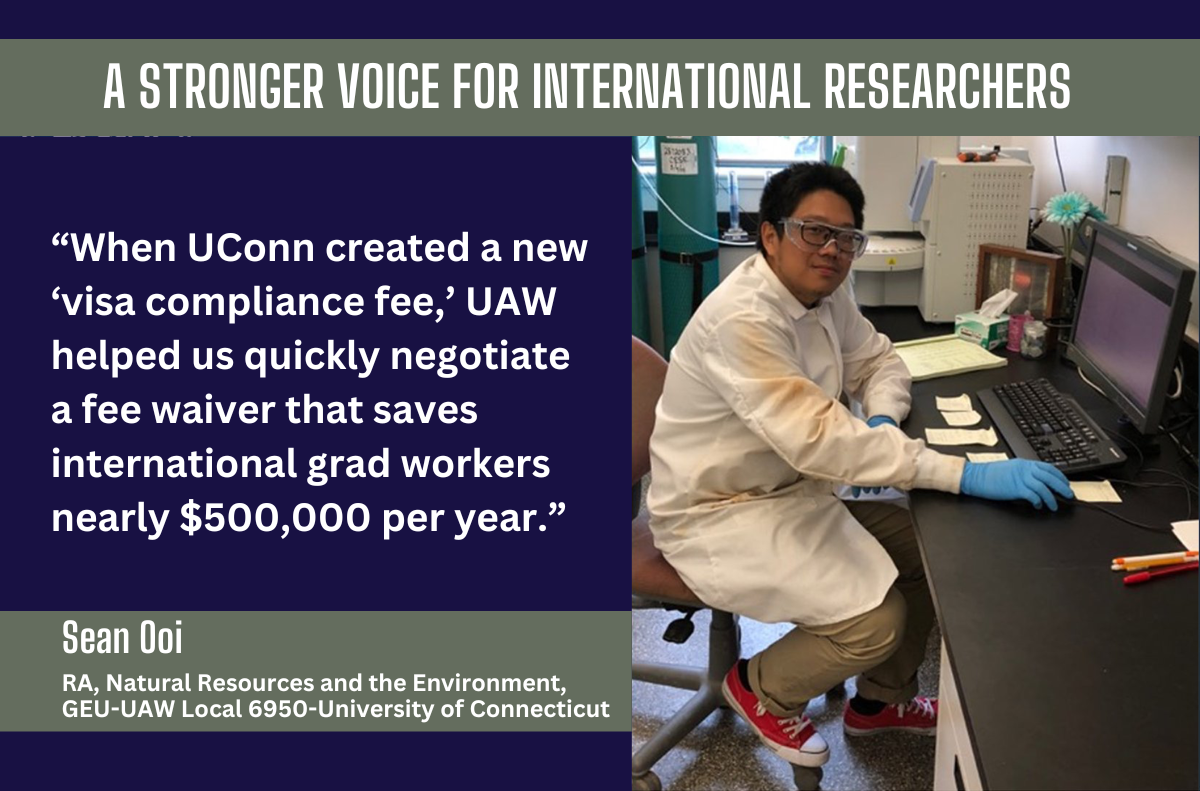
- Used collective bargaining to address issues in the workplace that especially impact international scholars, like winning guaranteed vacation days, waiving extra fees that international students and non-resident students are forced to pay, protecting the right to work from abroad during COVID-19, and protecting visa-holders from unjust termination.
- Worked for better US immigration policy, like increasing access to Optional Practical Training (OPT), opposing the “Fixed Duration of Status” rule, and working with members of congress Judy Chu (San Gabriel Valley) and Pramila Jayapal (Seattle) to oppose the 1-year period of validity for Chinese entry visas. The Western States International Working group, made up of international UAW members from across the west coast, has created this list of priorities for ongoing lobbying efforts.